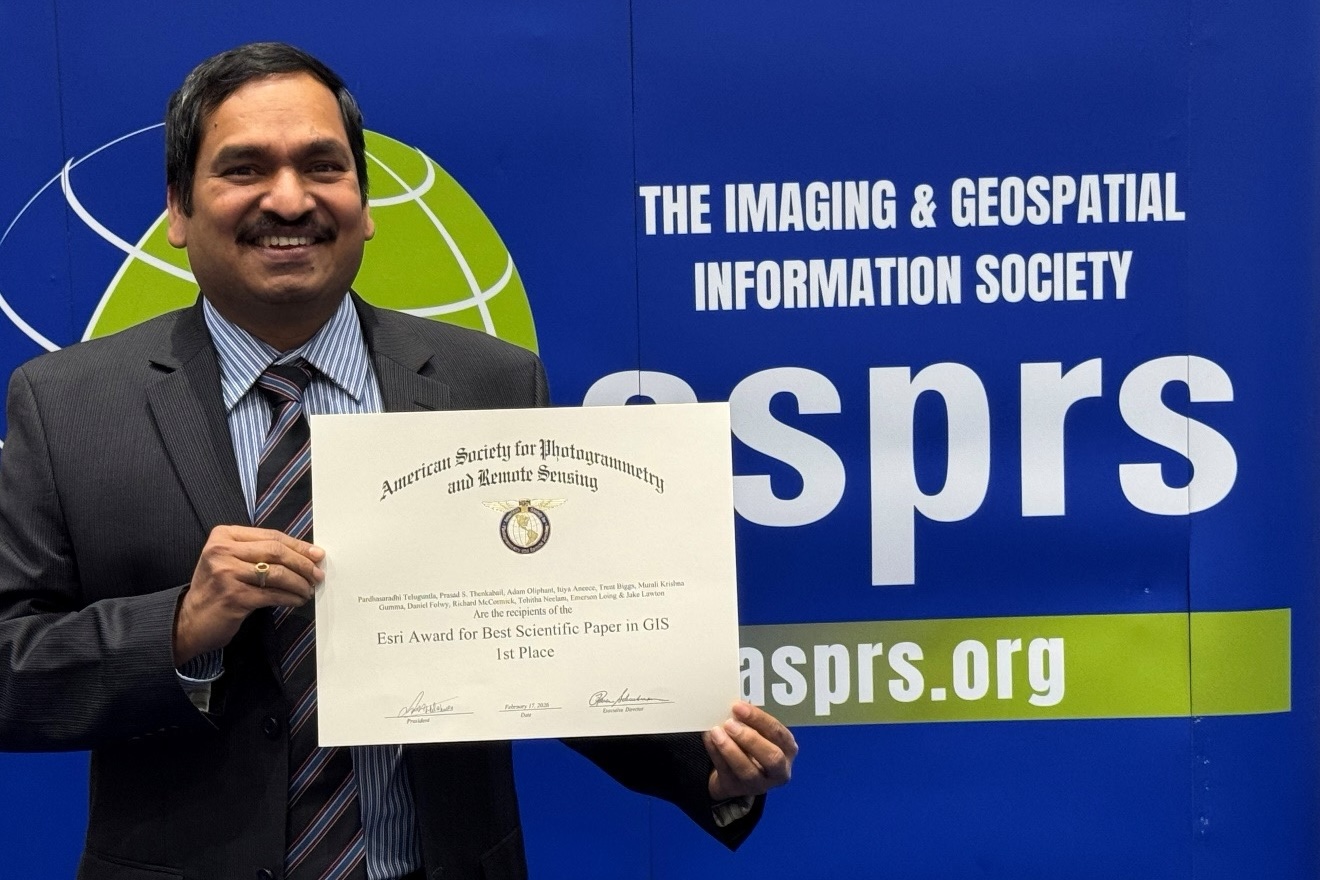
BAERI’s Pardhasaradhi Teluguntla (Pardha) (first author) and his co-authors have received the first place 2026…
BAERI Researchers Help Validate NASA’s PACE Ocean Color Instrument
How do we determine accuracy of satellite observations taken from hundreds of miles above the Earth? In the case of the PACE satellite, verification of data is accomplished by collecting measurements much closer to the ground through projects like AirSHARP.
PACE, or the Plankton, Aerosol, Cloud, ocean Ecosystem mission, by its definition, is designed to reveal “how aerosols might fuel phytoplankton growth in the surface ocean,” providing valuable information about algal blooms and more. AirSHARP (whose whopping acronym stands for Airborne aSsessment of Hyperspectral Aerosol optical depth and water-leaving Reflectance Product Performance for PACE) used a plane and a ship to collect the same kind of data as the satellite’s instrument, but much closer to the Earth’s surface. The PACE validation science team will compare AirSHARP’s data with the satellite data to ensure that they match and to evaluate how much the atmosphere may interfere with the satellite instrument’s reading. BAERI’s Samuel Leblanc and Kristina Pistone are part of the AirSHARP team and are featured in a recent article by BAERI’s Milan Loiacono.
Read that article here.
Related Posts