By Erin Bregman Daniel Ostrowski joins our video call from his meteorite lab, an unassuming…
In Conversation: Ariel Deutsch on Artemis II Lunar Science
April 22, 2026
Ariel Deutsch is a BAERI researcher at NASA Ames Research Center and part of the Artemis II Lunar Science Team. She is a planetary scientist who studies how the surfaces of other planets have evolved over time. Erin Bregman, BAERI’s Director of Communications, spoke with Ariel in March 2026, about a month before the launch of Artemis II. They discussed the work of the Artemis II Lunar Science Team and Ariel’s role in the Mission. This conversation has been edited for clarity.
Erin: I know you work on a bunch of different projects, but today I want to focus mostly on your work with Artemis. And so, for somebody who doesn’t know, what is Artemis?
Ariel: Artemis is NASA’s long-term effort to bring humans to the Moon and establish a sustainable presence there and develop technologies needed for future missions to Mars. Artemis II is a test flight, and the goal is always further exploration. Our team specifically is providing guidance on how to integrate science into that exploration.
Erin: Tell me about your team. What is the team, what does the team do, and what is your role on it?
Ariel: I’m part of the Artemis II Lunar Science Team. Broadly what we do is establish the lunar science objectives and develop the science observation plan that the astronauts will be completing as part of the Artemis II mission. It’s the first time that science has a console position inside JSC’s Mission Control Center. That’s different from Apollo and it’s a really big deal to have that representation on a flight console.
Erin: What is a flight console? Who usually sits there and why is that a big deal?
Ariel: If you think back to your favorite space movie, there’s probably a scene from the Flight Control Room, where you have massive screens at the front displaying trajectories and graphs and other data, and then each person is sitting behind a desk station wearing a headset. Each desk station represents a console, and each console has a very specific position to support mission operations, such as propulsion, or flight dynamics, or life support and power systems.
These console positions have historically been focused on engineering, communications, and other safety needs. And now, for the first time, we have a Science Officer console to provide immediate and real-time guidance within this operational environment. The Artemis II Science Officers will be responsible for integrating the mission’s scientific objectives, especially during the crewed lunar flyby. With support from the Lunar Science Team, the Science Officers help ensure that planned observations, measurements, and payload activities are properly timed, prioritized, and compatible with other spacecraft operations. Together, the Lunar Science Team will monitor incoming data for science value and support adjustments to observation plans if conditions change. The Science Officers relay relevant findings to both the flight control team and external science stakeholders.
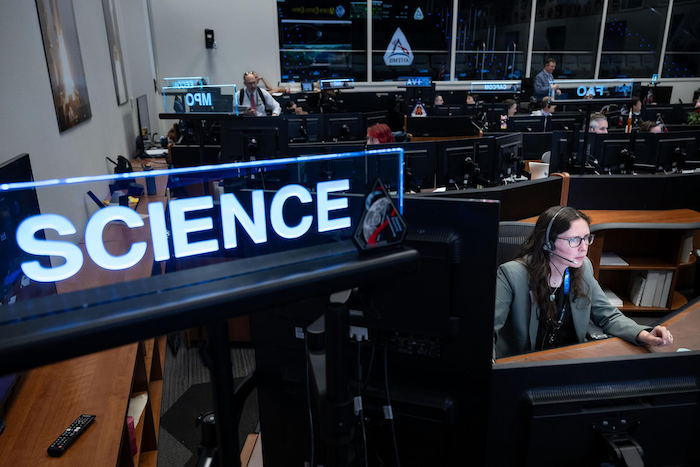
Artemis II Science Officer Kelsey Young monitors science operations at the new science console in NASA’s Mission Control Center on April 2, 2026. Image: NASA/Bill Stafford
So, our Science Officers are supported by the Lunar Science Team staffed in two additional rooms. We have the Science Evaluation Room, which is a brand new built-out facility, also in the Mission Control Center at JSC [Johnson Space Center], and that’s where I sit. And then we have a second room across campus at JSC that’s called the Science Mission Operation Room, or “the s’more” as they call it. In total, we have around around 35 team members staffed between these two rooms throughout the whole mission profile. Our team has a wide variety of expertise, from lunar and planetary science, to data visualization, to software development, and more. And our responsibilities change throughout the mission depending on what stage we’re in.
Erin: Are people there 24/7?
Ariel: The Flight Control Room is always 24/7, and between the Science Evaluation Room and Science Mission Operations Room, we are very close to 24/7.
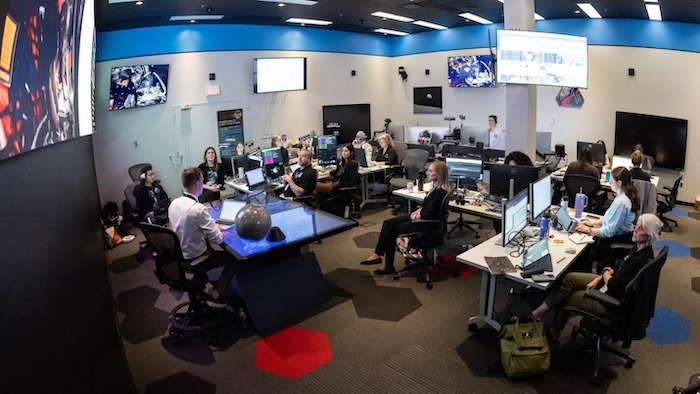
The Artemis II Lunar Science Team at work in the Science Evaluation Room (SER) in the Mission Control Center at NASA’s Johnson Space Center in Houston on April 3, 2026. Image: NASA/Luna Posadas Nava
In the Science Evaluation Room, our first big responsibility is creating the crew’s science plan. We call it the “Lunar Targeting Plan.” During the mission, there’s a point where the Orion spacecraft is closest to the lunar surface, and that provides the best opportunity for the crew to make science observations. We’ve actually been given five or six hours to completely determine what the crew will be doing with their time, which is a huge and exciting responsibility. We have a… NASA calls it a Science Traceability Matrix, but it’s basically a guiding document of the science objectives you are looking to accomplish with the mission.
Our mission is a little bit different from how traditional NASA science missions are built, because traditionally you start with the science and then build your mission and your instruments and your observations around that. But with this human spaceflight mission, we have to design our science plan within the specific constraints of the Artemis II mission profile. So to develop the Lunar Targeting Plan, we must plan the crew’s science observations based on what’s possible with the equipment and trajectory that NASA has defined for this mission. And the trajectory won’t actually be defined until after Orion’s Translunar Injection burn, which is scheduled for Flight Day 2. The spacecraft’s trajectory influences the illumination and viewing conditions that the crew will have of the Moon during their flyby, and so it determines what parts of the Moon and what other planetary bodies will be resolvable to the crew during flight.
We prepare for the mission using informed estimates of launch windows and Orion’s trajectory to model what the crew can see and from what distance, etc. and to build out a possible realistic Lunar Targeting Plan. But then our first job after TLI [Translunar Injection] is to rerun those models and refine the science plan to define where we want [the astronauts] to image and observe and when and why.
As you could imagine, there are some targets that are tied down to the second, really. For example, when does Earth come into view and when does it set behind the Moon? And then there are other targets that we have more flexibility in scheduling into the crew’s observations. …The first few days of the mission is finalizing what we send up to the crew as their science plan.
The plan is developed by the Lunar Science Team’s “Scrum,” which consists of five subject-matter experts on our team’s various science themes. My role on the mission is being one of these five experts and also being the Artemis II Scrum Lead. Each Scrum member is responsible for analyzing the trajectory-specific visibility of lunar and space targets and prioritizing the most optimal targets to address their themes. The Scrum works together to build a proposed target list with optimized coverage of the STM [Science Traceability Matrix] themes and priorities and works with a Timeline Manager to draft the timeline for lunar observations. The targeting plan is then reviewed, discussed, and approved by the entire Lunar Science Team.
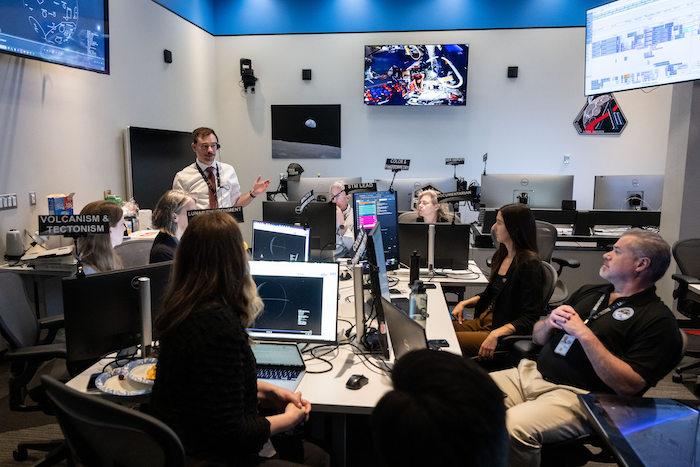
The Artemis II Scrum (clockwise, starting from Ariel: Anthony Colaprete, Jennifer Heldmann, Debra Needham, Juliane Gross), STM Lead (Ryan Ewing), and Documentarian (Barbara Cohen) deliberating with the Co-Deputy Lunar Science Lead (Jacob Richardson, standing) during the mission on April 3, 2026. Image: NASA/Bill Stafford
And then, day five or six, we have the lunar flyby. At this time, the crew will be making observations using the science plan that we sent them. [They] will be collecting three types of scientific data to support the plan—verbal descriptions, images, and annotations. During the flyby science activities, we’ll hear some initial reports from the crew, as they call down reports straight from Orion to Earth. But there are also times, especially as the crew passes behind the far side of the Moon, that we won’t have any communication, because there’s no direct line of sight from Earth to the Moon at that point. But after completing their entire Lunar Targeting Plan, the crew will initiate transfers of their audio recordings, images, and annotations for downlink back to Earth.
In my next shift, we’ve hopefully received some of that data. How much data we receive will depend on the quality of the communication signal, which is influenced by Earth’s view of the spacecraft, weather on Earth, and what other high-priority data needs to be downlinked first. Our teams in the Science Mission Operations Room and Science Evaluation Room will begin analyzing the data as soon as it is downlinked, because we have an opportunity to have a 30 minute-ish conference with the crew about eight hours later. This conference will be a direct conversation between one of our Science Officers in the Flight Control Room and the crew. And the way that the Lunar Science Team thinks about it is: what really important questions do you need to ask the crew before they leave the field, so to speak? A lot of us come from geology backgrounds, so this conference is akin to doing a critical scientific debrief in your exploration zone, before you return home. So, in support of this crew conference, we start going through their data; we start going through the images they took, the transcripts they recorded. They have a computer device that they take notes on, so we can go through their field notes, etc., and we will generate a list of high-priority debrief items and questions for the conference.
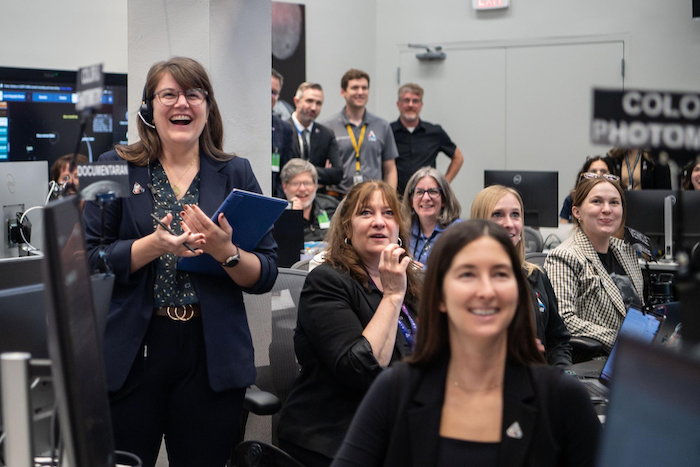
The Artemis II Lunar Science Team reacts to astronauts’ observations of Moon features during their flyby on April 6, 2026. Standing on the left is Artemis II Co-Deputy Lunar Science Lead Marie Henderson. In the right foreground is Ariel Deutsch, with Maria Banks behind her, Ryan Watkins to her right, and Sara Schmidt in the checkered jacket. Image: NASA/Luna Posadas Nava
During the remaining days, when the crew is traveling back home, we will continue to analyze their data. Although we don’t have a direct turnover time to meet with them again during that mission until they splash down, we’ll be able to continue those conversations later and understand their perspectives better. And then, just like with any NASA mission, we work on assembling reports to share the findings with the public and archive the data, so that anyone in the world can use it and continue to analyze it and learn from it.
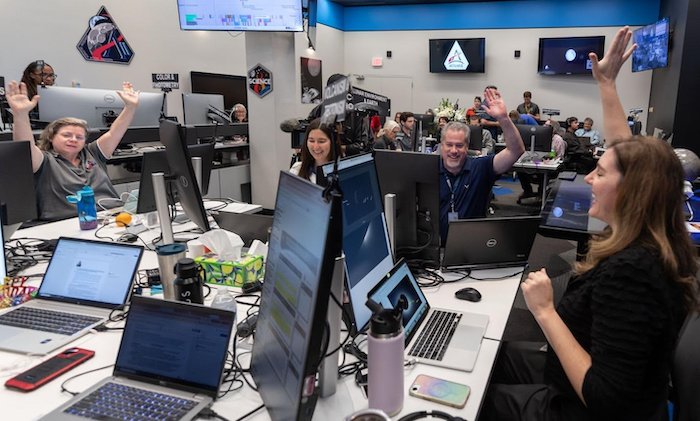
Members of the Lunar Science Team celebrate exciting data during the first day of downlink, including Barbara Cohen (left), Ariel Deutsch, Anthony Colaprete, and Jennifer Heldmann sitting around the foreground table. Image: NASA/Luna Posadas Nava
Erin: That’s a great overview. What are the science goals? What do you hope having people there looking at something can inform in a way that sending instruments can’t?
Ariel: First and foremost, human and robotic exploration are complementary approaches, each with distinct strengths, and neither is intended to replace the other. With Artemis II operations, we’re demonstrating how science supports exploration and exploration supports science. Humans will provide critical perceptual context that a robotic system can’t yet replicate with the same spatial awareness or level of intuition, as the crew can react and adapt their focus in an instant and make scientific interpretations.
Human eyes are actually very capable instruments, because they work at a continuous frame rate and actively adapt to their field of view, whereas cameras provide segmented captures at discrete time points, capturing only a cropped portion of the scene. Our eyes have the ability to pick up on subtle colors and hues in an impressively nuanced way as we adapt to our illumination conditions and dynamic views. And since Artemis II is part of this broader program of enabling a sustained human presence on the Moon, understanding how the human perceives and understands color and topography in unusual illumination conditions all feeds into understanding how we will be able to effectively operate during future landed missions.
We have 10 science themes, and they are prioritized by thinking about: what are the unique capabilities that humans bring to this specific mission? One high-priority theme is related to color and brightness, which I just spoke about. And the second [high-priority theme] is related to impact flashes, which was also part of the Apollo program. Impact flashes result from impacts striking the surface and provide information on how dynamic the modern lunar environment is. It’s a different space environment than we have here on Earth, under our protective atmosphere. And then there are other science themes related to the geology of the Moon, by exploring various impact craters and volcanic and tectonic terrains; and the lunar environment, such as characterizing dust in the lunar exosphere. We even have science themes related to various solar and deep space targets, such as other planets, stars, and galaxies.
Erin: When I hear you talk about the human eye getting to see all these nuances and observations, I wonder about the challenge of recording and describing that. I was recently on the top of a mountain with a friend, and I was like, “oh, look, there’s a whale.” And they’re like, “where?” And I thought: oh my gosh, I don’t know how in the world to tell them where this whale is spouting. I felt like it took me forever to figure out what to say and how to point, you know? It’s really hard. So how do you teach somebody to notice the right things and to record it in a way where other people can understand it? Like, does everybody see the same hue and interpret that as the same word?
Ariel: I love that example of the whale. That’s so true. It comes down to properly training the crew, and then trusting them to be the scientists on the mission. The Lunar Science Team has extensively trained with the crew, all the way from classrooms to field excursions to simulations. For this particular mission, it’s important to ensure confidence in the crew’s audio descriptions. Like you were saying, how do you notice and record the right things? The crew is trained to collect critical observational data with their images and recordings, and they have the fundamental training to make scientific interpretations, but this is a team mission, and they know they have the whole Lunar Science Team behind them to support them throughout the flyby and even after splashdown.
Erin: Is that teaching them what to notice?
Ariel: It’s teaching them what to notice; it’s teaching them how to observe macro to micro, so [noticing] large-scale patterns, then zooming in to more specific variations or features. It’s geology training. And we also teach them to trust their perceptions, because the human eye is a really powerful tool.
And also, how do you use your crew members to observe together as a team? In any team sport, having a solid team around you enables you to be better. It’s the same in scientific exploration. When we engage with others, we can share perspectives and exchange new ideas, enabling the team to learn from each other’s expertise to reach more robust conclusions. The crew exemplifies this teamwork, as they are intentionally capturing images to narrate the story that they’re seeing together.
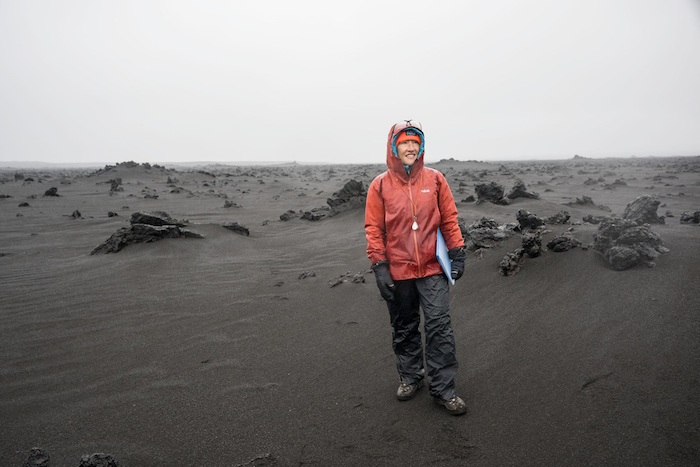
Christina Koch, a member of the Artemis II Crew, Geology Training in Drekagil, Iceland. August, 2024. Image: NASA/Robert Markowitz
Erin: There are so many different skills that go into that.
Ariel: Yes.
Erin: You mentioned simulations and field missions. Are there any times you can think of that made you think: Oh wow, it’s really good we practiced that.
Ariel: Yeah. Like, everything. I mean, we sim [simulate], and they sim every aspect of their mission. There are so many sims that the crew does that aren’t at all related to the science. For the science sims, we sim both with the crew and without them, because we want to be the best team we can to support them.
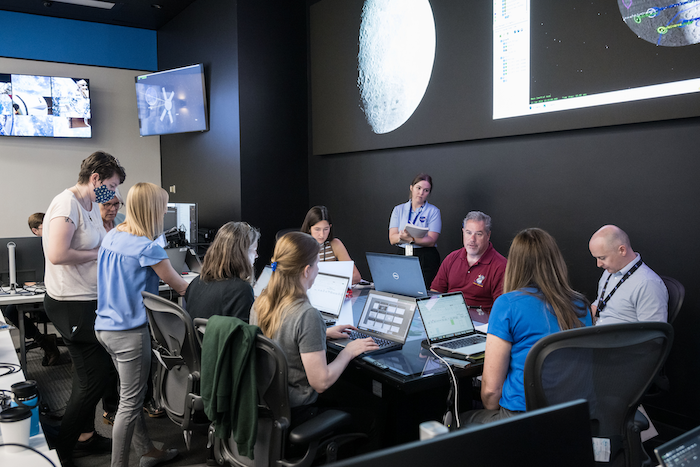
Members of the Lunar Science Team during a sim in June 2025 in the Science Evaluation Room. Image: NASA/Robert Markowitz
Erin: It’s so interesting to hear you talk about how integrated science is, because that was going to be one of my other questions, about what the legacy is from Apollo and how science integration has changed since then. One of the things that I was reading before we talked was about the science training history of Apollo. And there’s this fabulous quote talking about the very, very beginning planning stages of Apollo and…I’ll just read it. [from “Science Training History of the Apollo Astronauts,” by William C. Phinney] “It became apparent that once the astronauts got to the Moon, it would be prudent to have them accomplish something on the lunar surface. Max Faget, the director of engineering at the Manned Spacecraft Center (MSC), is quoted as saying, ‘it wouldn’t look very good if we went to the moon and didn’t have something to do when we got there.’”
Ariel: That’s amazing.
Erin: So, if that’s where it started, and now science is actually fully embedded, that’s a really big difference. And so I’m curious, how much does it still feel like this way of thinking is where it all started?
Ariel: That was the beginning of Apollo, but by the end of Apollo, I think the missions really were viewed as science missions. Even though science didn’t have a flight control console, there was a “science backroom” that was staffed by lunar scientists and geologists, who also were essential to crew-training activities.
Erin: And there was even a geologist astronaut, right? By the end?
Ariel: Yep, in Apollo 17 [Jack Schmitt]. So science really made its way into the Apollo legacy for sure, and I think the later Apollo crews had excellent leadership and excitement in contributing to science.
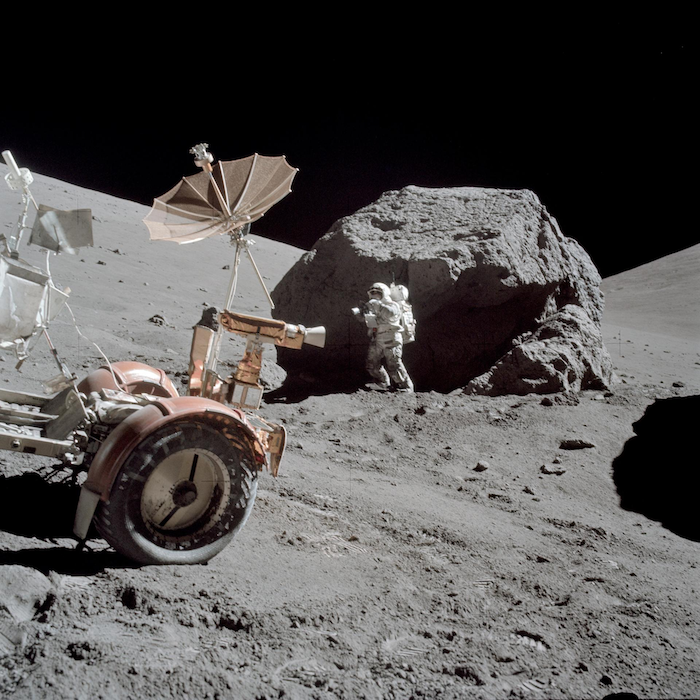
Scientist-astronaut Harrison H. Schmitt on the lunar surface during Apollo 17 on December 13, 1972. Image: Eugene A. Cernan/NASA.
I can say that the Artemis II crew is the same way. They are the most curious and dedicated learners. They really want to understand the material, because they take their scientific data collection opportunities very seriously. They want to make sure that the data they acquire are what we’re looking for. And that’s just super cool to witness.
Erin: That is really cool. How did knowledge transfer happen? With so many years’ gap between Apollo and now, how were the lessons learned brought through?
Ariel: Certainly through various pathways. For example, Apollo had very good documentation, which has always been a fantastic first point for knowledge transfer. And then some people that were involved in the Apollo program are still around today. We had the fortune of having a meeting with the man that trained the Apollo astronauts for their orbital observations [Dr. Farouk El-Baz], and his perspective on how he implemented training and how he was able to excite and interest the crew was such a valuable conversation.
Erin: Was there anything that you took from that conversation and then did?
Ariel: Oh yeah. His take-home point of enabling the crew to be the scientists and trust their own perceptions is something that we really took forward. You know, you can plan for the things that you want the crew to see or want the crew to do, but at the end of the day, the most game-changing data are going to be the things you didn’t ask for or expect. So striking a balance between defining the crew’s observations while also providing them with the time and tools to explore and discover is very critical.
Also, from a personal side, my PhD advisor at Brown [University], Dr. Jim Head, was one of the Apollo astronaut trainers, so I have the fortune of learning from his experiences as well, all through grad school and still today.
So our team certainly learns from the Apollo program, as well as from various exploration missions that have occurred since, all the way from deep ocean and remote field exploration here on Earth, to lunar and deep-space exploration. And then, as you can imagine, as much as Artemis is building off of all the lessons learned from Apollo, Artemis is different in many ways. And so some things just have to get developed with the times, so to speak.
Erin: In that same vein… let me see if I can find this story I found. Or maybe you’ve already heard it, about one of the astronauts buying a handheld camera at the drugstore?
Ariel: I don’t know this story.
Erin: Okay, let me see if I can find it… here we go: “The first attempt at actually accomplishing any science on a manned flight was that of John Glenn in his five-hour Mercury flight of February 18, 1962. In addition to attempting the astronomical observations that had been suggested, Glenn thought it would be good to have a camera along to take pictures from orbit. A 35mm camera was bought at a local drugstore, and he used it on his flight. As Glenn tells the story: ‘At that stage of Project Mercury, cameras were considered too great a distraction to an astronaut. They would keep him from performing his array of scientific tasks…. The slide-rule and computer contingent lacked the imagination to see the value of photographs that would help translate an astronaut’s experience for anyone who saw them. They had their checklists, and that was all that was important.’ Glenn went to Bob Gilruth and complained, ‘This is ridiculous. I need to take some pictures, because people are going to want to see what it looks like to be an astronaut.’ Gilruth agreed, and the search for a suitable camera commenced. It had to be small enough to fit in one hand, allow the advance of the film with the thumb, and snap the shutter with one finger, all of which could be manipulated while wearing a pressure glove. The machine shop tried to adapt several cameras to the requirements, but, according to Glenn, ‘nothing worked very well.’ While Glenn was in a drugstore at Cocoa Beach, he saw a small Minolta camera in a display case. ‘I picked it up and thought “Jeez, it’s got automatic exposure.” That was brand new at the time. You didn’t have to fiddle with light meters and f-stops. I bought it on the spot for $45…. It turned out to be more readily adaptable than any of the others.’ It was the one he used on his flight.”
Ariel: Wow. That is so cool.
Erin: Isn’t that amazing?
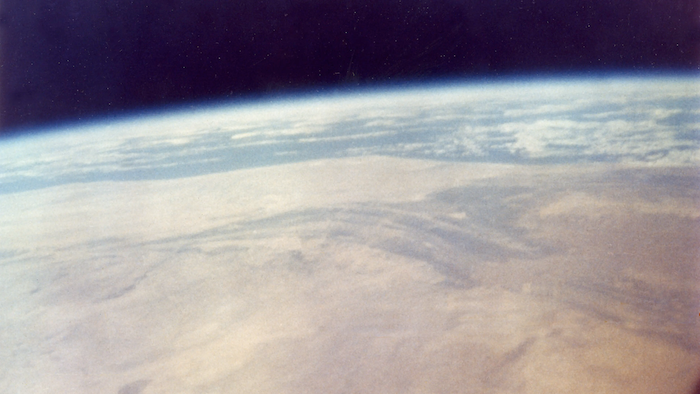
Color photograph of North Africa from space, taken by John Glenn in the Friendship 7 spacecraft during NASA’s Project Mercury-Atlas 6 mission, Feb. 20, 1962. Image: John Glenn Archives—The Ohio State University
Ariel: I love that, and I feel like it’s such a characteristic that we see with the crew today, too. They take…ownership in some ways, and also they take what they do very seriously. It’s like: “How am I going to maximize my experience, not only for myself but for everyone.” And that’s just so cool that that was also part of Apollo.
Erin: Yeah. And the idea that you could go up there and not take photographs is crazy.
Ariel: Yeah.
Erin: I imagine that the cameras between now and in 1962 are quite different, so it makes me curious what the imagery will be like coming back, with a human there on the other side of the camera versus pointing an instrument from far away.
Ariel: Yes, exactly. … they’re responding to what they see, which is the power of putting people out there. And it goes back to that principle of: narrate your observations with your images. There are also cameras on the outside of [the spacecraft] Integrity, so there’s science that can be done with aligning the images from the vehicle views with what the crew saw.
Erin: That’s great. And one final thing that I ask everybody, and so I’ll ask you too: What does science mean to you?
Ariel: Science, to me, is the privilege to ask questions that we don’t know the answers to. The answers can change as we learn more. And science builds on itself as we try to understand the world around us and even beyond.
Erin: That’s a really beautiful answer. Thank you so much for sitting down and chatting today.
Ariel: Oh my gosh, yeah. Thank you for the opportunity.
Erin: And good luck with Artemis!
Ariel: Thank you!
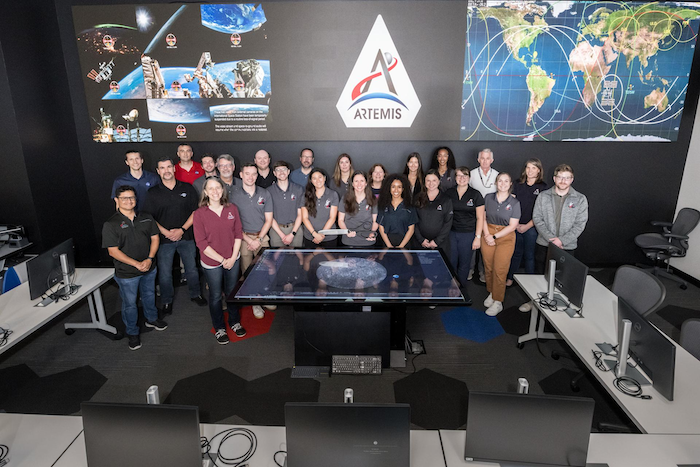
Members of NASA’s Artemis II Lunar Science Team in the Science Evaluation Room (SER) at the agency’s Mission Control Center at Johnson Space Center in Houston, June 2025. Image: NASA/Helen Arase Vargas
Related Posts