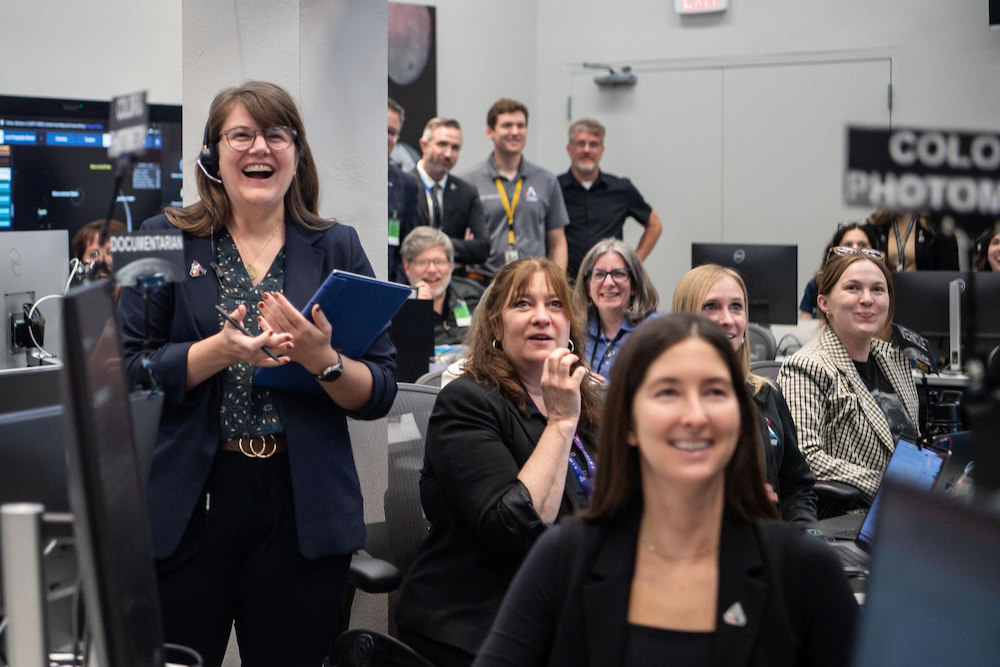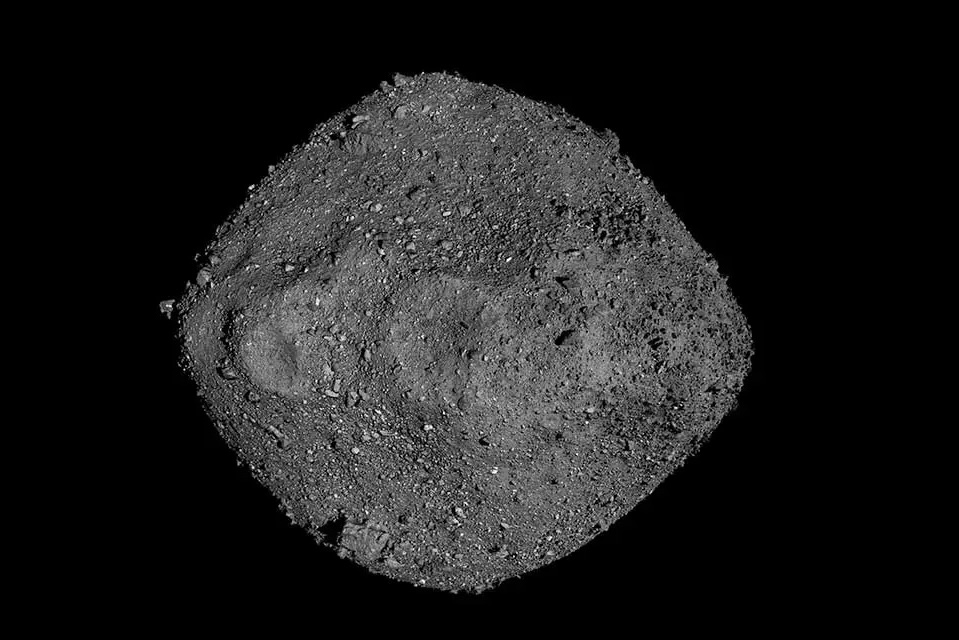
April 22, 2026 Ariel Deutsch is a BAERI researcher at NASA Ames Research Center and…
Characterizing Meteorites with the Asteroid Threat Assessment Project
By Erin Bregman
Daniel Ostrowski joins our video call from his meteorite lab, an unassuming beige-walled room at NASA’s Ames Research Center in Silicon Valley that’s about the size of a small hotel room. A few minutes into our conversation, Daniel (who goes by Dan) steps offscreen and comes back carrying a battered USPS Priority Mail box. He reaches in, pulls out a black rock about the size and shape of a goose’s beak, and holds it up to the camera so I can see all of its curves and bumps and polished edges. This, he tells me, is an iron meteorite. He turns the rock to show me the single side he cut open to reveal the rock’s interior. Inside, it’s a luminously milky white.
Like most meteorites, this one was once part of an asteroid, a small rock that orbits our Sun. At some point in its travels through space, a piece of that asteroid broke off and became a meteoroid. The meteoroid, caught by the pull of Earth’s gravity, entered our atmosphere—at this point it became known as a meteor. As the meteor hurtled through the atmosphere at high speed, friction with air molecules caused it to heat up and burn. If you’d caught a glimpse of the meteor as it sped down, you may have pointed it out as a shooting star.
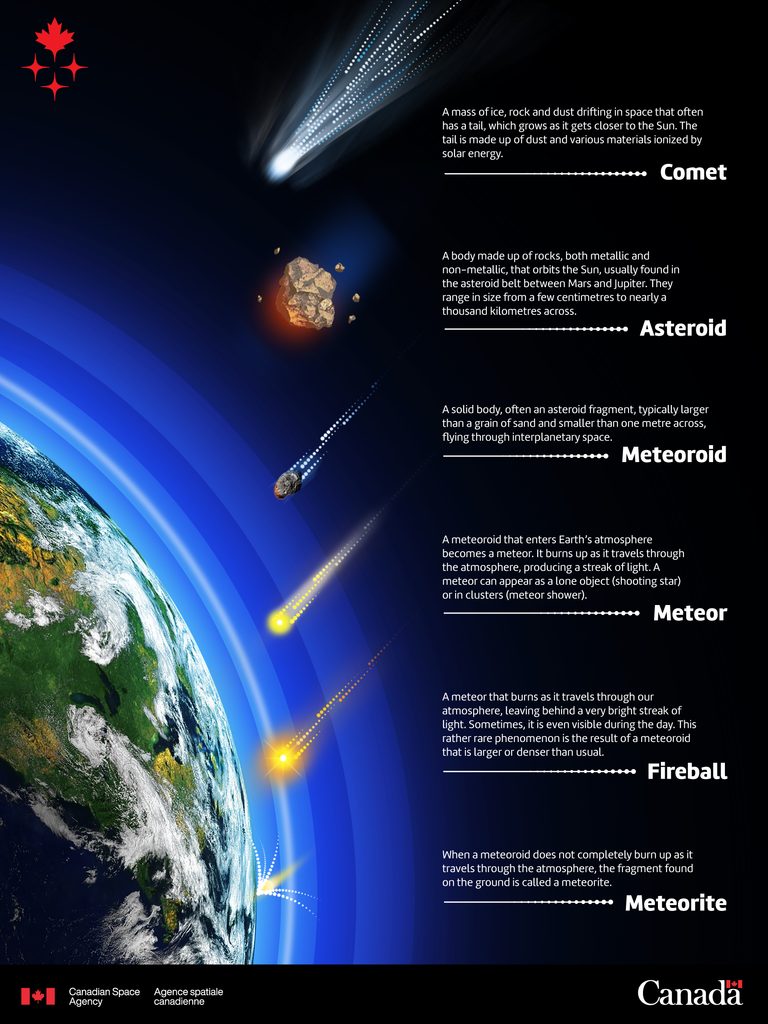
Image: Canadian Space Agency.
Some meteors burn up entirely in the atmosphere, leaving nothing for us to see except that fleeting trail of light. But the one in Dan’s lab was among the many that do survive, at least in part, and make it all the way to the surface of the Earth. Once a meteor lands, we call it a meteorite. The goose-beak meteorite, after a long journey through space and a short hot ride through our planet’s atmosphere, was found by a human, picked up, and eventually arrived in a cardboard box at Dan’s meteorite lab door.
Dan is a researcher with the Bay Area Environmental Research Institute (BAERI). His job, and the reason he receives a steady stream of meteorites, is to conduct a series of tests to learn more about the properties of these space rocks. Why? Because if a dangerous-looking one comes straight at Earth someday, it would be helpful to know ahead of time: will this one break apart in the atmosphere without causing a shock wave, or are we about to have a much bigger set of problems?
The Asteroid Threat Assessment Project and the Planetary Defense Coordination Office
Dan does his work as a member of NASA’s Asteroid Threat Assessment Project team, or ATAP for short. Located at NASA’s Ames Research Center, ATAP is part of NASA’s larger Planetary Defense Coordination Office (PDCO), which finds, tracks, and attempts to better understand the space rocks that could someday be a threat to Earth. Unlike other missions and programs within the PDCO that focus on finding near-Earth objects and assessing their chances of hitting Earth, ATAP is researching what would happen if one of them did reach our planet. Would there be a shock wave? How damaging would that be? Would the impact cause a tsunami? How big?
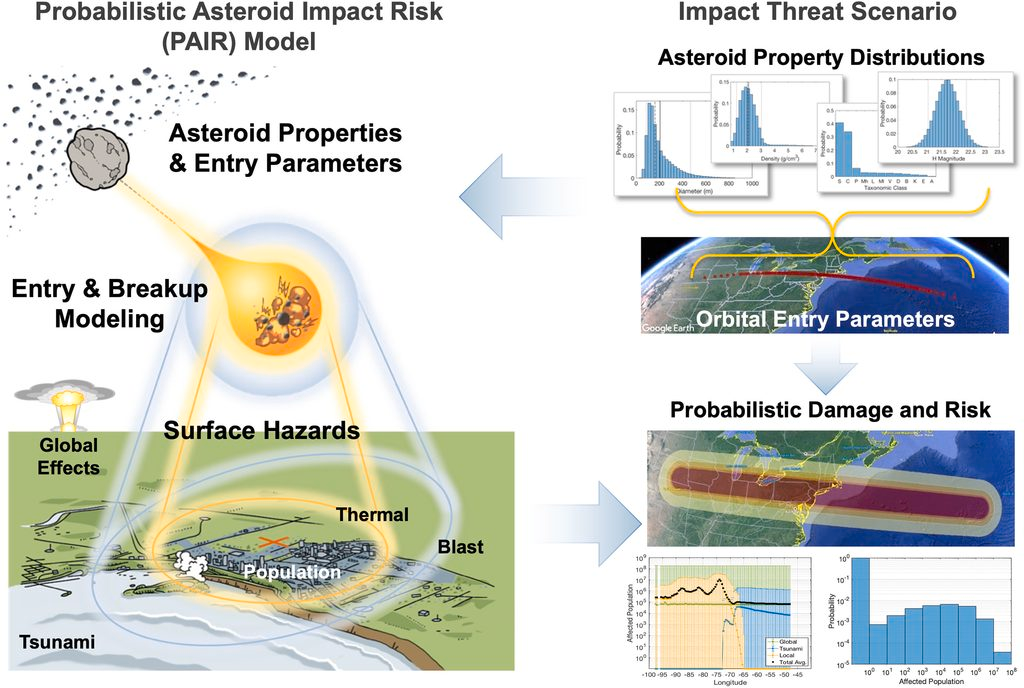
Diagram showing the PAIR modeling process for assessing potential asteroid impact threat scenarios. Plots shown represent generic model components, not specific inputs or results. Image: Lorien Wheeler. NASA/Ames.
ATAP’s team of about 20 researchers are working to answer these questions. The group makes up one of the key technical areas of the NASA Advanced Supercomputing Division (NAS) at NASA Ames. Lorien Wheeler, ATAP’s Impact Risk Assessment lead, says that being located at Ames is key for the ATAP group because of both the aerospace reentry expertise at the Center and its extensive supercomputing resources. “In terms of the asteroid problem,” explains Wheeler, “one of the really big challenges is that you’ve got a lot of really high energy physics going on and also very large spatial domains…And then also the need to resolve high-fidelity physics over that entire domain. So supercomputing is really, really critical in being able to do that.”
To model all of the factors that go into assessing the potential risk of an impact, you need to know a wide range of details about the space rock you’re dealing with. Some of the information can be calculated from telescope observations, like how fast a near-Earth object is moving, what trajectory it’s on, and its approximate size range. But that information alone won’t tell you very much about what happens once it hits Earth’s atmosphere. Asteroids of the same size but different strengths can behave quite differently from each other as they travel through Earth’s atmosphere: one might break up harmlessly, another might burst apart at low altitude and cause a damaging shock wave, and yet another might survive intact all the way to the Earth’s surface.
As a result of this complexity, ATAP researchers are broken up into different teams, and each team works on a different piece of the asteroid threat puzzle. Dan’s meteorite lab is part of the characterization team, which focuses on learning more about an asteroid’s physical properties by collecting measurements, or “ground truth” data. Other ATAP teams work with different types of computer models to simulate what happens during atmospheric entry, the details of the impact hazards asteroids can cause (like air bursts and tsunamis), and the risks those hazards could pose to people.
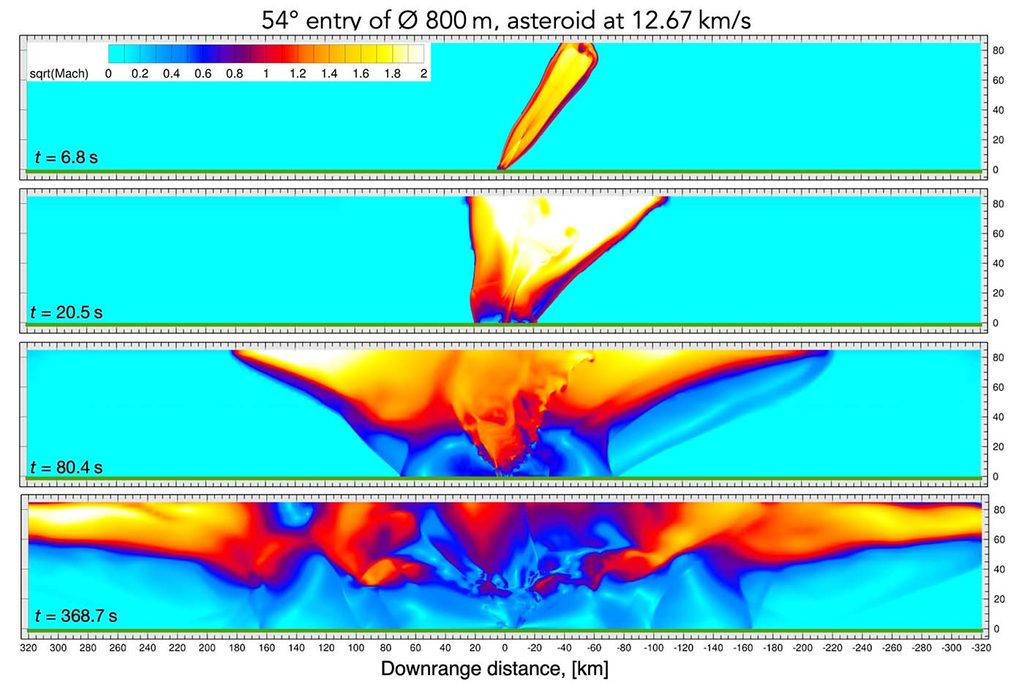
Snapshots from a simulation of the entry, impact, and blast propagation over the first six minutes after entry of the hypothetical asteroid PDC 2023, illustrated through local Mach contours. While the entry and impact occur in only seconds, the blast takes about 12 minutes to reach the domain boundaries. Michael Aftosmis, NASA/Ames.
Because it’s not feasible to go out and take samples of a wide range of asteroids while they’re in outer space, BAERI researchers instead study the meteorites that have made it to Earth and use that information to better understand what the asteroid was like before it entered Earth’s atmosphere and how it likely changed on the way down. Donovan Mathias, current NAS Division Chief and former lead of ATAP, explains it like this: “If we can figure out what the composition is of an item that lands on the ground, then we can use that to make inferences about what it was before it came into the Earth’s atmosphere… Those aren’t the same…things change through atmospheric flight… And [meteorite properties are] the best ground truth data that we have in general.”
Measuring Meteorites
The creation and organization of that ground truth data is at the core of Dan’s work in the meteorite lab. He spends his days taking measurements to capture four different types of information about each meteorite that arrives at his lab: density, porosity, thermal conductivity, and acoustic velocity. Together, these measurements help paint a detailed picture of the rock’s physical properties, which is essential for understanding how each type of rock is likely to behave in the extreme conditions that come with a trip through Earth’s atmosphere.
The first step, Dan tells me, is to cut at least three equally sized cubes from the meteorite. The physical properties of rocks aren’t uniform throughout, so making the same measurements with multiple cubes help him get an accurate average for the entire meteorite.
Finding a rock’s density is the most straightforward of the four properties (the density of a material is its mass divided by its volume), and is the first measurement Dan makes with any new sample. He weighs each meteorite cube, uses a 3D scanner to find its volume, and calculates the sample’s density.
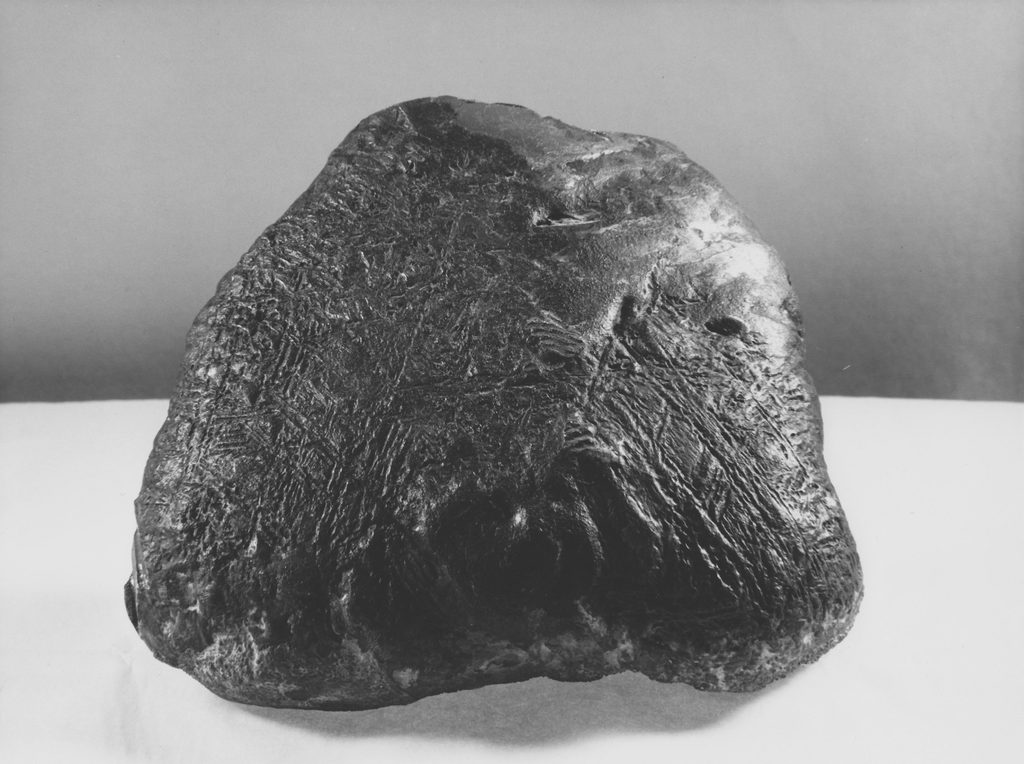
This iron-nickel meteorite found near Fort Stockton, Texas, in 1952, is about 15 centimeters (6 inches) across and is in the collection of Texas Christian University. Image: NASA.
From there, he moves to measuring porosity, which is a measurement of the empty spaces within a rock, including tiny cracks, holes, gaps, or longer fissures. He points out a small box sitting below a laptop behind him. “That little grey, tan-ish box is a pycnometer,” Dan says. The pycnometer forces gas into each meteorite sample, which allows Dan to take a measurement of the samples’ grain density, which is the density of just the mineral grains that make up the rock. Because he already knows the volume of each cube, he can use this grain-density measurement to calculate the sample’s porosity.
One of the sample cubes Dan cuts from the meteorite is specifically set aside for the next measurement, thermal conductivity, which is the experiment Dan has running as we talk. In terms of assessing how much damage an incoming asteroid has the potential to do, a major factor is knowing how much of it will burn up in the atmosphere and therefore how much will be left over to impact the surface. “Thermal conductivity is one of the properties used for ablation,” Dan tells me. In other words, it’s one of the key measurements that provides information about how much of a meteorite’s material will be shed during atmospheric entry.
While there are many labs that do thermal-conductivity tests on meteorite samples, Dan explains to me that most of them are interested in how the rock behaves in space conditions, which means they only focus on very cold temperatures. In contrast, he says, his lab is “focused on high temperature, for atmospheric entry.” And, it turns out, a rock’s thermal conductivity is quite different when that rock is very hot and when it’s very cold. It’s so different, that having these high temperature measurements has significantly changed the understanding of when an incoming space rock will reach “melt phase,” which means the temperature at which its surface will begin to melt and vaporize.
Making these high-temperature measurements has shown researchers that, compared to what was previously understood, “the time to reach melt phase is actually twice as fast,” says Dan. For anyone worried about incoming asteroids, this is good news. It means that any incoming rock is going to start burning up earlier than was thought, which in turn means that “the objects that we have to worry about have to be bigger than we thought in the past,” Dan explains.
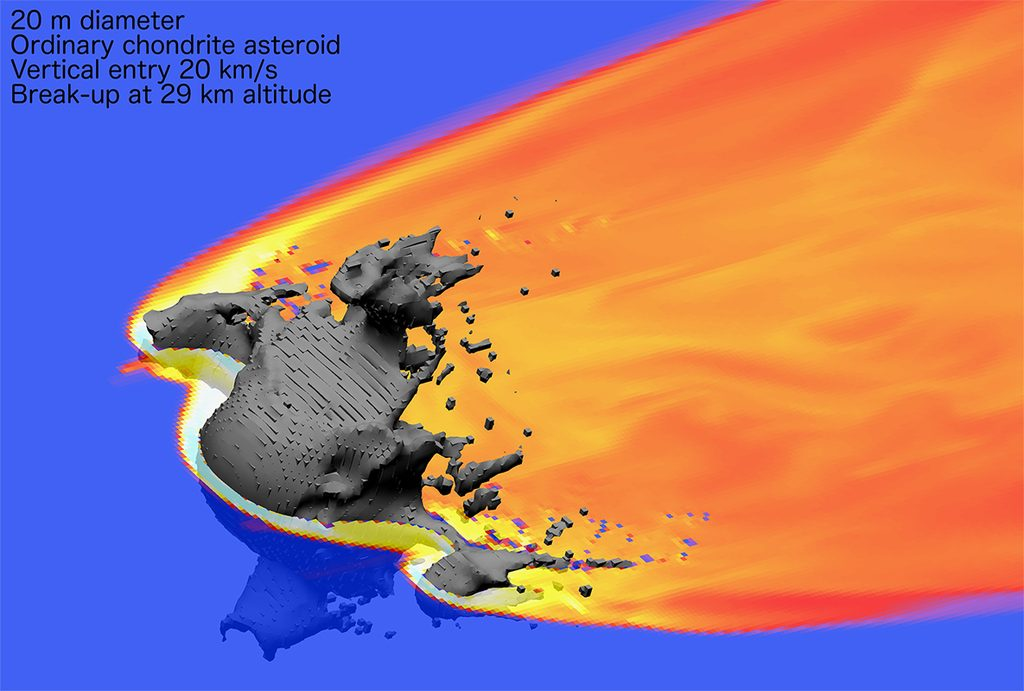
Simulation of an asteroid breaking up during atmospheric entry. Entry velocity of 20 km/s creates a hot, high-pressure shock wave around the asteroid that causes it to rapidly fragment and burn up. Larger asteroids can survive all the way to the ground where they will create a large crater. Image: Darrel Robertson, NASA/Ames.
For information so important and complex, finding a rock’s thermal conductivity is relatively easy to measure: Drill two small holes in the sample, and place temperature sensors (called thermocouples) inside them. Then, heat one side of the cube and measure how quickly the heat moves from one sensor location to the other, and you have a measurement for thermal conductivity.
The last measurement Dan makes is acoustic velocity, which captures the speed at which sound moves through the meteorite sample and helps measure a rock’s strength. For decades, sound waves have been used to determine the strength of a rock and for everything from earthquake research to tunnel construction. The relationship between sound and a material’s strength exists because of what sound waves physically are—a series of compressions and expansions that move from one particle to the next. At the most basic level, these compressions and expansions move more quickly through materials that have stronger atomic bonds. And it’s the strength of these bonds that Dan measures when he sends a sound wave through a rock sample: the faster the sound waves move, the stronger the bonds, the stronger the rock.
“The reason why we’re doing acoustic velocity is because you can get the ‘elastic moduli’ from that,” Dan explains. “Elastic moduli” are measurements of a material’s stiffness, or how likely it is to temporarily deform when a stress is applied to it. Dan measures the acoustic velocity across three different axes of a sample to help measure the material’s assumed strength. To get beyond “assumed” you need to measure additional types of forces that aren’t possible when you’re working with a limited resource. “The only contemporary way to get to those strength numbers is to literally destroy the rock,” Dan says. “It’s not like we can easily just go crush a whole bunch of [meteorites]. A standard geology test…they would probably make something like 50 to 100 puck-sized samples and destroy them all. We don’t have enough meteorite stuff to do that.”
Dan pulls out a handheld instrument to show me how he takes this measurement. It’s a small black meter, about the size and shape of a handheld radio, minus the antenna. Off the shelf, the instrument, an “ultrasonic thickness gauge,” is meant to measure the thickness of known materials, like walls or pipes. “We had to have the manufacturer flip the software for us,” Dan tells me. In its intended use case, the user is working with a known material, which means they know the speed of sound through that material and are using the device to learn the object’s thickness. “We were like, ‘no, we know the thickness,’” said Dan. It is the speed of sound through the material they want to learn. To do so, he attaches a probe to the meter and one to the sample. All it does, Dan explains, is “constantly pulse a wave through at a certain frequency and record the amount of time it takes for the signal to come back to the receiver.”
ATAP Data in Use
Dan’s measurements and the resulting data play essential roles in improving the ATAP team’s ability to accurately model the risks of a potential asteroid impact. All models need inputs, and the inputs for ATAP’s “Probabilistic Asteroid Impact Risk Model” (PAIR) include those physical properties Dan is measuring—density, porosity, strength—and the “ablation coefficient” which, as Dan mentioned, is connected to thermal conductivity. With those inputs (and many more) the PAIR model uses a huge amount of computer power (thanks, NAS!) and complex physics to arrive at a range of outputs for a given impact scenario, which includes maps and human population counts of regions potentially at risk, what they’re at risk from (blast, thermal radiation, tsunami, etc.), and how severely.
The data that Dan collect are also part of a growing, publicly available database of known properties of asteroids and meteorites, which catalogues the properties that are most useful to the global scientific community focused on planetary defense.
The meteorite lab’s current focus is specifically on learning more about two subtypes of the most common type of meteorites found on Earth, a group called “chondrites.” Chondrites are stony (non-metallic) meteorites that were formed out of dust and small grains when our solar system was very young. They make up the vast majority of space rocks, so they’re the most likely kind of meteorite to impact Earth. In addition to being non-metallic, chondrites are defined as rocks that have never been modified either by melting, or by a process called “differentiation of the parent body,” which means that the larger object it broke off of never separated into different layers like our planet did, with a core, mantle, and crust.
A Meteorite in Hand…
It was a chondrite that exploded in an air burst over Chelyabinsk in the Ural mountain region of Russia on February 15th, 2013, just after sunrise. The explosion, briefly brighter than the Sun, generated a shock wave that shattered glass, collapsed a factory roof, damaged over 7,000 buildings, and injured over 1,000 people. “I have some of that [meteorite] in my research lab, and I was able to see a lot quicker than the modelers why it actually airburst and didn’t make it to the ground,” Dan tells me. According to the models, Dan says, the meteor should have either made it to the Earth’s surface or airburst a lot closer to the ground—both of which would likely have caused more damage than it did. As rich in data as the models are, it turns out they couldn’t take into account one of the things that simply can’t be known about an asteroid from afar: how fractured it is and how close those fractures are to the rock’s surface. “[The fractures were] not just circular or oval voids,” Dan explains, “…[but] actual long-run cracks throughout it. And as soon as some of those were exposed [to the atmosphere], it just shattered.”
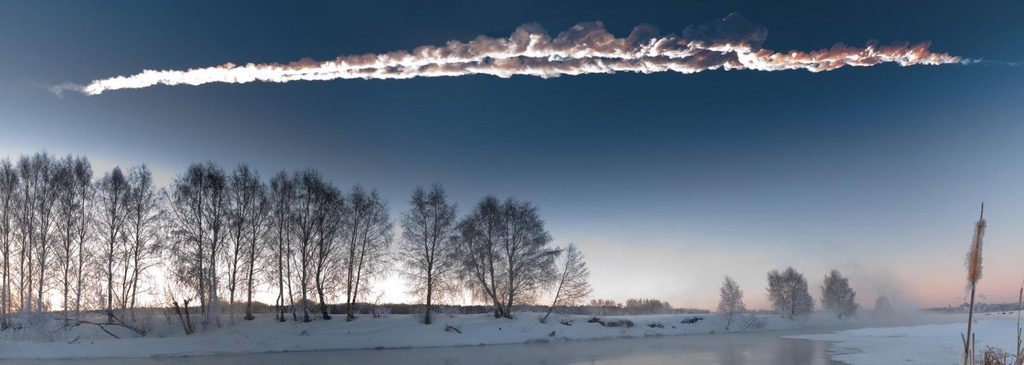
Vapor cloud trail left by the Chelyabinsk asteroid as seen by M. Ahmetvaleev on February 15, 2013. Image: M. Ahmetvaleev/ESA.
After Chelyabinsk, during a monthly meeting, Dan didn’t need any scientific instruments to help him demonstrate what had happened to the meteorite once one of those long-running cracks was exposed to the atmosphere. When the ATAP group was discussing why the meteor had behaved differently than the model, he used the geologists’ technique: “I had some extra pieces,” Dan tells me, “and I just showed them I was able to crush it in my hand.” As he tells the story, Dan mimes holding a small piece of the meteorite between his thumb and forefinger, then makes a quick gesture of crumbling the rock with minimal effort. “I’m like: ‘This is why.’”
With what we know right now, no scientist can pinpoint how any Earth-bound meteor will behave before it’s “tested” by Earth’s atmosphere, and no model can perfectly capture every variable. But ATAP researchers are doing what all scientists do best: processing data and extrapolating from observations in the real world—incrementally narrowing the gap between hypotheses and reality.
Further reading:
Lorien Wheeler, Jessie Dotson, Michael Aftosmis, Ashley Coates, Grégoire Chomette, Donovan Mathias (2024), Risk assessment for asteroid impact threat scenarios. Acta Astronautica, 216: 468-487. https://doi.org/10.1016/j.actaastro.2023.12.049.
D. Ostrowski and K. Bryson (2020), Laboratory examination of the physical properties of ordinary chondrites. Meteorite & Planetary Science, 55: 2007-2020. https://doi.org/10.1111/maps.13562
D. Ostrowski, K. Bryson (2019), The physical properties of meteorites. Planetary and Space Science, 165: 148-178. https://doi.org/10.1016/j.pss.2018.11.003
Donovan L. Mathias, Lorien F. Wheeler, Jessie L. Dotson (2017), A probabilistic asteroid impact risk model: assessment of sub-300m impacts. Icarus, 289: 106-119. https://doi.org/10.1016/j.icarus.2017.02.009
Related Posts